
GrafGuard® expandable graphite flakes are an additive that greatly enhances intumescent fire protection when used in steel coatings, especially when combined with other fire-retardant additives. Pairing GrafGuard expandable graphite with a phosphorus-based intumescent, such as ammonium polyphosphate (APP) or melamine polyphosphate (MPP), and a metal hydroxide, such as aluminum trihydroxide (ATH) or magnesium dihydroxide (MDH), produces a highly synergistic effect. These combinations yield earlier char formation, denser, more stable char layers, enhanced cooling effects, and superior performance in standard fire tests such as ASTM E84, ASTM E119, and UL 1709, compared to using other fire-retardant chemicals or GrafGuard expandable graphite flake alone.
The intumescent graphite char created by NeoGraf Solutions’ GrafGuard expandable graphite not only insulates steel from heat but, when reinforced by APP/MPP char and ATH/MDH residues, remains cohesive under extreme fire conditions. The result is improved fire resistance, char stability, and fire test performance – including lower flame spread, reduced smoke generation, multi-hour fire endurance, and robust protection even in rapid, high-temperature hydrocarbon fires.
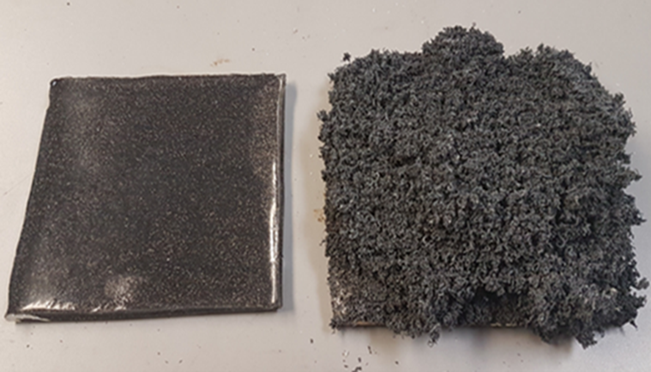
Figure 1 – A steel plate coated with a 0.3mm thick GrafGuard expandable graphite centered epoxy coating before and after exposing to a flame. The expanded char measured nearly 100mm thick.
Synergistic Mechanisms of GrafGuard Expandable Graphite with APP, MPP, ATH, & MDH
GrafGuard expandable graphite is an exceptional intumescent material that rapidly expands around ~200-300 times in volume when heated, forming a thick carbonaceous char foam that thermally insulates steel substrates. Unlike traditional intumescent additives, which rely on charring a polymer binder at higher temperatures, for example, APP decomposes at ~250-280 °C, melamine at ~300 °C, GrafGuard expandable graphite can be engineered to activate at relatively low temperatures, starting at 160-280 °C, depending upon the grade. This means in a fire scenario, GrafGuard expandable graphite begins foaming early in the temperature rise, forming a protective char well before the steel gets hot or other additives kick in. The graphite-based char is essentially pure carbon and remains stable at extreme temperatures, as graphite sublimes at ~2500 °C, converting to carbon dioxide, and it does not burn away in a fire. GrafGuard expandable graphite’s performance is greatly improved when combined with other fire-retardant ingredients.
Specialty phosphorus-based minor intumescents like ammonium polyphosphate (APP) or melamine polyphosphate (MPP) are commonly added alongside GrafGuard expandable graphite to produce additional char and intumescent gases at higher temperatures. When the temperature reaches ~ 250-300 °C, APP/MPP decomposes, releasing phosphoric acid and non-flammable gases. The acid carbonizes adjacent resin or polymers into char, while gases, such as nitrogen from melamine or other blowing agents, expand that char into a foam. In a GrafGuard expandable graphite centered coating, this secondary intumescence stage complements the initial GrafGuard graphite expansion.

The graphite char formed at ~ 160-200 °C provides an early insulation layer, and then the phosphate intumescent yields additional char that intermixes with and bonds the graphite “worm” structure. The combined char is thicker and more coherent than either component alone. The graphite supplies volume and high-temperature stability, while the phosphate/polyphosphate creates a denser carbonaceous matrix that reinforces the char. This synergy significantly improves the mechanical integrity of the protective layer, helping it adhere to the steel and resist cracking or erosion under fire conditions. In fact, internal tests at NeoGraf found that formulations blending GrafGuard expandable graphite with other intumescent additives, such as APP or MPP, showed the greatest reductions in steel temperature rise during fire exposure, far outperforming formulations without GrafGuard expandable graphite.

Mineral fire-retardant additives such as aluminum tri-hydroxide, ATH, and magnesium di-hydroxide, MDH, are endothermic flame retardants that release water when heated as the water of hydration is released around 200–330 °C. The released water vapor absorbs heat, cooling the material and diluting combustible gases, helping to slow fire propagation. When incorporated with GrafGuard expandable graphite, these metal hydroxides do not intumesce, but they enhance the graphite char’s performance. The water released cools and delays heat transfer to the substrate, and the residual metal oxide Al2O3 or MgO integrates into the char, adding an inorganic ceramic skeletal structure that improves its compression and erosion resistance while reflecting some heat back to the source. By prolonging the “active” cooling phase during a fire and fortifying the char after water release, ATH, and MDH function as ideal synergists for GrafGuard expandable graphite centered systems.
Notably, the most effective formulations use a combination of all three elements – GrafGuard expandable graphite, a minor intumescent such as APP or MPP, and a metal hydroxide such as ATH or MDH. Each component addresses a different aspect of fire protection:
- GrafGuard expandable graphite: Provides immediate, low-temperature expansion into a voluminous insulating char, shielding steel early in a fire.
- APP/MPP the phosphate intumescents: Provide a secondary charring phase at mid-range temperatures around 250-300 °C, yielding phosphoric acid that generates a binding the char and intumescent gases like nitrogen and ammonia that swell the char, resulting in a denser, stronger char layer with better adherence to the substrate.
- ATH/MDH or other metal hydroxides: Decompose endothermically, ATH at around 220 °C, and MDH at around 330 °C, to release water, cooling the substrate and flames, and leaving heat-resistant oxide solids in the char. The elongated evaporation path through the GrafGuard expandable graphite formed char prolongs cooling and further reinforces char strength and integrity at high temperatures.
Through this multi-component synergy, GrafGuard expandable graphite centered coatings can achieve a balance of rapid intumescence, strong char formation, and heat absorption, surpassing the capabilities of any single additive alone. The expanded graphite char will not burn, and the augmented char layer remains intact and insulating even in prolonged fire exposure.
Enhanced Fire Resistance and Standard Test Performance
Surface burning testing, such as the ASTM E84 Steiner tunnel test, shows that GrafGuard expandable graphite centered intumescent coatings can achieve Class A ratings for flame spread and smoke development. The GrafGuard expandable graphite component ensures that flames are rapidly smothered, as the coating quickly swells into a thick carbonaceous foam. It significantly reduces flame propagation, as measured by the Flame Spread Index (FSI), to ≤ 25. The synergistic additives further improve this performance. The phosphoric acid-based char bonds with the graphite layers, and metal hydroxides contribute to cooling, yielding a char that stays in place despite the test’s high-velocity airflow. This prevents the char from being torn off and exposes less fresh surface to the flame, keeping the FSI within Class A limits. The Smoke Developed Index (SDI) is also very low. The graphite char is pure carbon with no halogens, and the use of APP/MPP, which releases phosphoric acid derivatives, CO2, nitrogen, and ammonia, plus ATH/MDH, which releases water, means minimal smoke production below the SDI 450, which is the threshold for Class A. Overall, a GrafGuard expandable graphite + APP/MPP + ATH/MDH system can create a self-extinguishing, low-smoke coating that meets the most stringent E84 requirements for building materials.
Structural fire endurance tests, such as ASTM E119/UL 263, for intumescent steel coatings containing GrafGuard graphite in synergy with APP or MPP and ATH or MDH demonstrate excellent fire endurance, often achieving 1 to 3 hour fire-resistance ratings on structural steel, such as columns and beams, under the ASTM E119 standard heating curve. The GrafGuard expandable graphite char, which forms at low temperatures, immediately slows the heating of the steel substrate. As temperature rises, the APP/MPP yields additional char and gaseous expansion, while ATH/MDH decomposes to actively absorb heat, keeping steel temperatures well below the critical level of around 540°C for extended periods.
Because GrafGuard graphite’s intumescence is so efficient, the required coating thickness can be kept relatively low, often only a few millimeters for a 2-hour rating, compared to legacy formulations without GrafGuard graphite. The combined char remains in place and insulative even as furnace temperatures approach 1000 °C, preventing steel from reaching its failure temperature within the rated time frame. In practice, this means GrafGuard expandable graphite flake centered systems can maintain structural integrity significantly longer during a fire, buying valuable time for occupants to evacuate and for fire services to respond.

High-intensity hydrocarbon fire tests, such as UL 1709, are more extreme, simulating a jet-fuel or hydrocarbon pool fire with temperatures of ~1100 °C reached within minutes. A GrafGuard expandable graphite centered coating with its synergistic additives is crucial for char stability. The violent, high-heat flux conditions of a UL 1709 exposure can cause weak chars to erode or detach, but GrafGuard expandable graphite’s expanded char is inherently refractory and, when reinforced with phosphoric acid-derived char and metal oxide residues, it stays adhered to the steel substrate.
GrafGuard expandable graphite improves char strength and cohesion, helping the intumescent coating resist the erosive blast of the fire. As a result, GrafGuard expandable graphite centered intumescent epoxy coatings can keep structural steel below 538 °C for 2-3 hours, even in a severe hydrocarbon fire, meeting UL 1709 requirements. This level of protection is difficult to achieve without the combined synergy of GrafGuard expandable graphite, APP/MPP, and ATH/MDH to provide both an immediate thermal barrier and a durable char that withstands the high heat release rate of hydrocarbon-fueled fires.
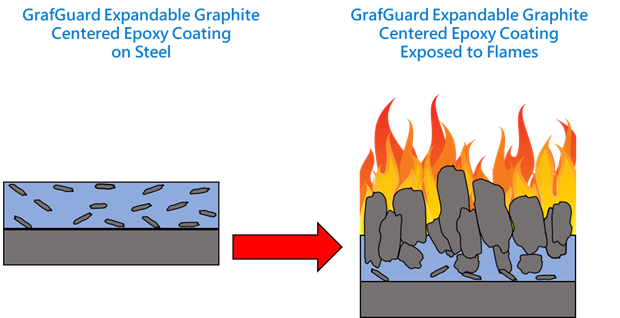
Figure 2 – A schematic of a steel plate coated with GrafGuard expandable graphite centered epoxy coating before and after exposing to a flame. The materials exposed to the flames react first starting the multi-additive protection of the substrate, while establishing an insulative char.
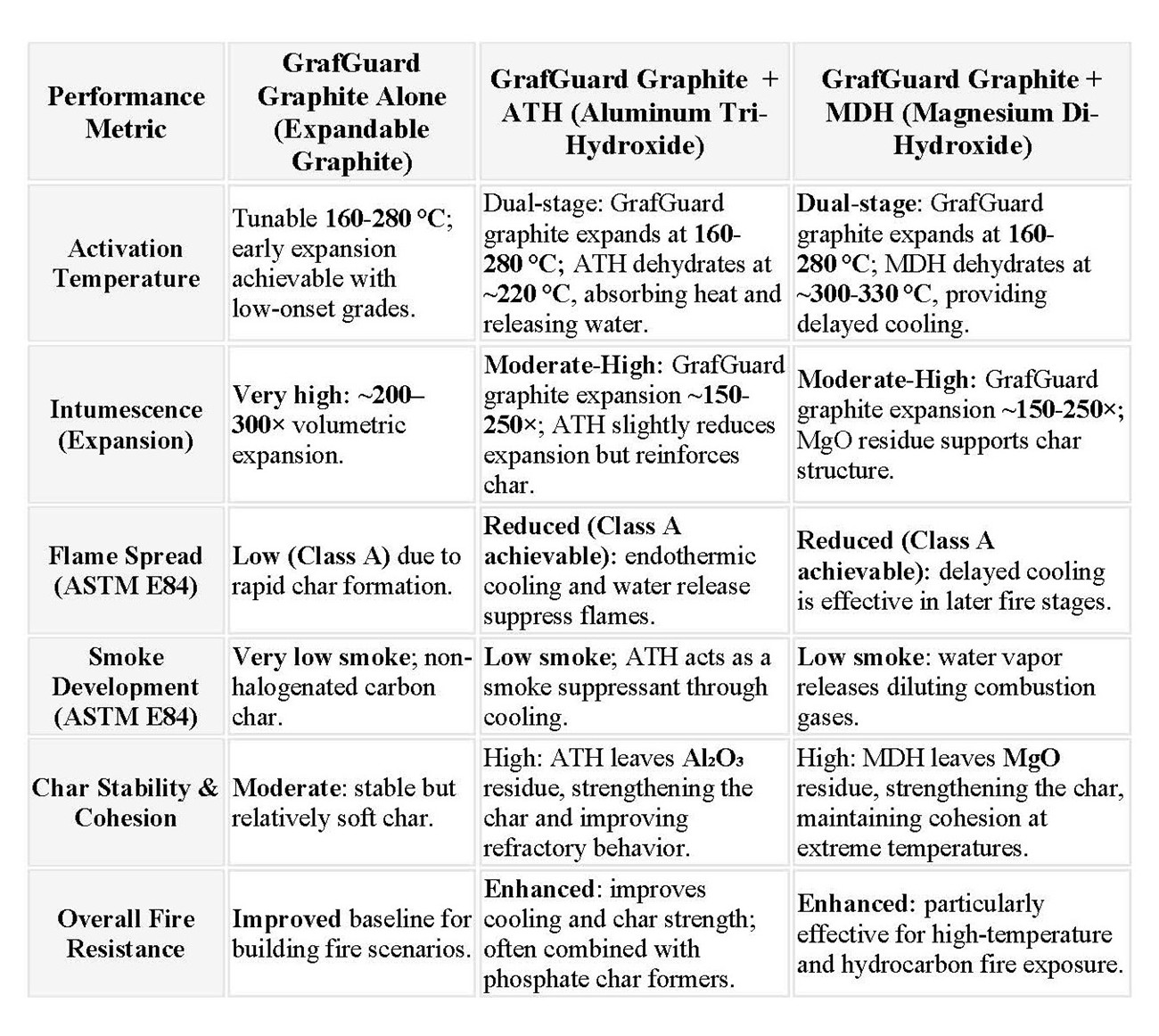
The two tables below compare a GrafGuard expandable graphite alone solution to a combination GrafGuard expandable graphite centered solution with APP, MPP, ATH, and MDH across key performance metrics, highlighting how each synergistic additive contributes to improved fire protection:
Table 1. Comparison of a GrafGuard Expandable Graphite Solution Alone vs. GrafGuard Expandable Graphite Centered Phosphate-Based Synergistic Systems (APP and MPP)
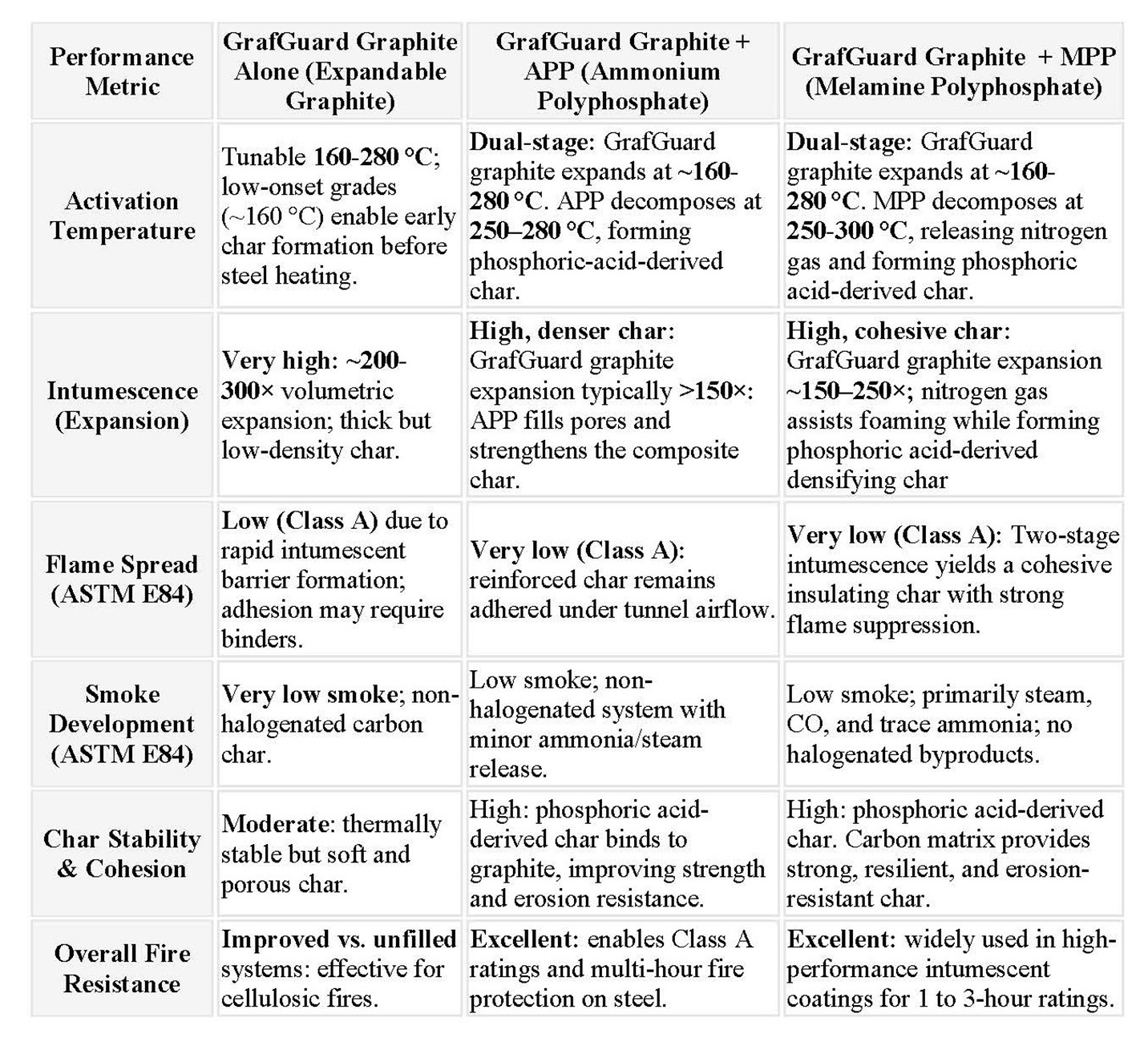
Table 2. Comparison of a GrafGuard expandable Graphite Solution Alone vs. GrafGuard Expandable Graphite Centered Metal Hydroxide Synergistic Systems (ATH and MDH)
Conclusion
NeoGraf Solutions’ GrafGuard expandable graphite centered coatings formulated with synergistic additives like APP/MPP and ATH/MDH yield intumescent steel coatings that activate quickly, form robust insulating char, and withstand even the most stringent fire tests. Such synergistic formulations exhibit reduced flame spread and smoke that meet ASTM E84 Class A requirements and provide extended fire endurance for structural steel, often achieving 2 to 3-hour ratings in ASTM E119/UL 263 and UL 1709 tests. GrafGuard graphite flake centered multi-additive approach enables high-performance fire protection with thinner, lighter coatings, delivering critical improvements in safety and structural fire integrity over traditional single-additive systems.
+1 (800) 253.8003 (Toll-Free in USA) | +1 (216) 529.3777 (International)
www.neograf.com | info@neograf.com
NeoGraf Solutions, LLC (NGS). This information is based on data believed to be reliable, but NeoGraf Solutions, LLC makes no warranties, express or implied, as to its accuracy and assumes no liability arising out of its use. The data listed falls within the normal range of product properties but should not be used to establish specification limits or used alone as the basis of design. NeoGraf Solutions, LLC liability to purchasers is expressly limited to the terms and conditions of sale. eGraf®, Graf+®, GrafGuard®, GraFoil®, NeoNxGen®, and GrafCell® are registered trademarks of NeoGraf Solutions, LLC. SpreaderShield™, HiTherm™, Graf-X™, Graf-M™ are trademarks of NeoGraf Solutions, LLC. These trademarks are not a comprehensive listing of all NeoGraf products or trademarks used or owned by NeoGraf Solutions, LLC. eGraf®, NeoNxGen®, SpreaderShield™, HiTherm™, Graf+®, Graf-X™, Graf-M™, GrafGuard®, GraFoil®, GrafCell®, and NeoNxGen®, products, materials, and processes are covered by several US and foreign patents. For patent information www.neograf.com.
© NeoGraf Solutions
4.2026
